Reform UK Business Day: Key Takeaways for Business
Written by Alex Reeves
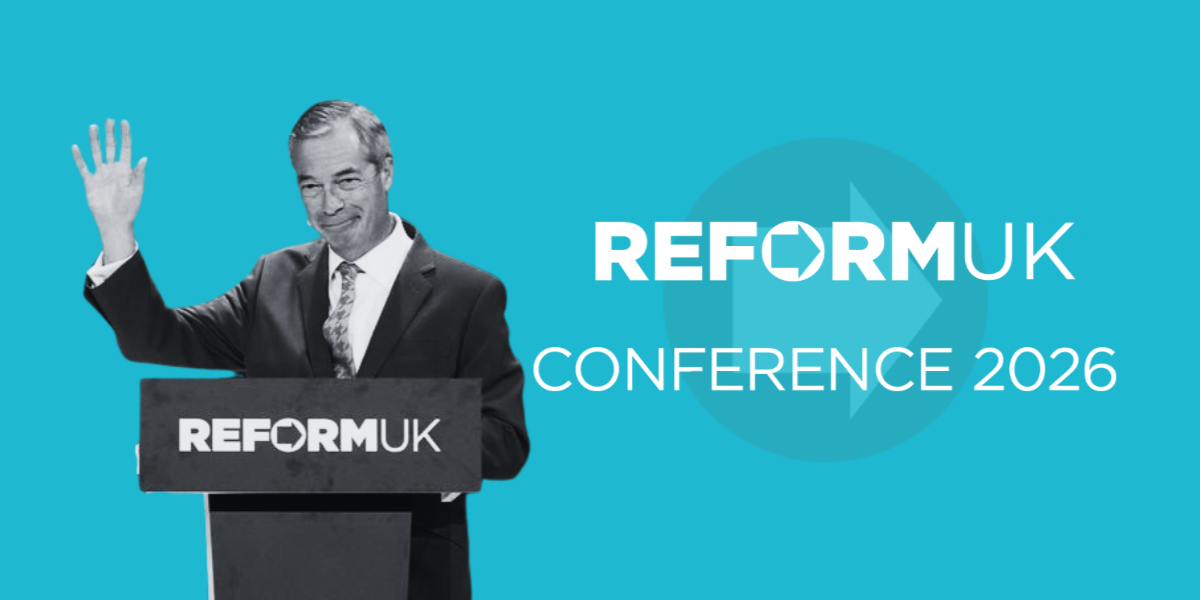
Yesterday was Reform UK’s first ever Business Day at its annual conference in Birmingham. It was a useful opportunity to get a better sense of how the party is thinking about business and the economy, although the format itself is still clearly developing.
Our overall impression was that it felt more like another day at conference than a genuinely bespoke business event. Much of the discussion came through fringe sessions and appearances from Richard Tice and Robert Jenrick, rather than the more tailored sessions and private roundtables you might expect from a dedicated business day. Leader Nigel Farage also did not address business delegates at any point, which was notable given Reform’s focus on building credibility with business and investors. There were nevertheless some clear messages from the day.
1. Competitiveness, planning and energy are at the heart of Reform’s economic offer
Richard Tice and Robert Jenrick were consistent on the need to make it easier and cheaper to invest and operate in the UK. Tice focused heavily on sovereign capability, British manufacturing and reindustrialising the UK, with planning reform a particular priority. Reform’s new Planning Teal Paper sets out proposals to speed up development and reduce the costs associated with the planning system. The party is also seeking responses on its planning and business rates proposals by 31 December 2026. Jenrick made a similar case around infrastructure and energy. His argument was that businesses should not be paying significantly more for energy than international competitors if the UK wants to attract and retain manufacturing investment.
There is a fairly simple message behind this: Reform sees planning, energy and regulation as major barriers to growth and wants to reduce the cost of doing business.
2. Labour market policy will be an important area for business
Jenrick was particularly critical of the Employment Rights Act and the increase in employer National Insurance, arguing that the latter should be wound back and replaced, in part, through a levy on foreign workers. More broadly, Reform is trying to establish itself as the party of workers and employment, with a strong focus on reducing welfare dependency and getting more people back into the workforce. There is still a lot of detail to work through here, but employment costs, labour supply, immigration and employment regulation are likely to be important areas for businesses to engage on. Reform UK also promised a £15,000 tax-free allowance increase, announced by Robert Jenrick.
3. Fiscal credibility is clearly a priority
One of the more interesting parts of Jenrick’s contribution was the emphasis on reassuring financial markets. He said Reform would seek to hold a Budget within its first 100 days in government and identified potential savings of £70-80 billion, including tackling the growth in welfare spending. He stressed the importance of sound money, restoring market confidence and creating the conditions for interest rates to come down. He also confirmed that Reform would retain the OBR, although he wants to reform it to improve forecasting and bring greater diversity of thought into the process. He argued that the Treasury also needs to rebuild its own forecasting capability. This is an important signal. Reform is clearly conscious that, if it is to form a government, it will need to convince financial markets that it can manage the public finances responsibly.
4. Energy policy is likely to remain pragmatic
The focus was firmly on the cost and reliability of energy rather than a particular technology. Jenrick argued that the UK should pursue whatever forms of energy can provide cheaper and more reliable supply, including North Sea oil and gas, nuclear and renewables. He was sceptical of subsidising forms of generation that Reform believes are unnecessarily expensive. For energy-intensive businesses, this is likely to be an important area to watch and engage on as the party develops its policy.
5. Defence is being linked closely to industrial policy
Cai Parry Jones MS, speaking on defence policy, argued that Reform would push for 3% of spending to go towards “genuine defence”, alongside the longer-term NATO commitment of 3.5% by 2035. More interestingly from a business perspective, he linked this directly to rebuilding UK manufacturing capability and supply chains. He highlighted existing manufacturing clusters, including in Sheffield, and argued that the UK needs to become much more capable of producing defence equipment domestically. This points to a potentially significant focus on sovereign capability, defence procurement and UK supply chains.
What this means for business
Reform UK now has a fairly clear diagnosis of the problems it wants to address – high business costs, expensive energy, a difficult planning system, weak industrial capacity and pressure on the public finances. The next question is whether it can turn that diagnosis into detailed, credible and deliverable policy. For businesses, there is value in engaging now, while there is still scope to influence what that policy looks like.
However, that will be tested against a more difficult political backdrop. The party is facing growing media scrutiny of Nigel Farage and its senior team following the latest donations controversy, with allegations around the handling of foreign funding and polling now leading to the resignation of influential Head of Policy James Orr and senior aide Dan Jukes, pending the outcome of the party’s investigation. For a party seeking to convince business and investors that it is ready for Government, how it responds to this scrutiny and whether it can maintain focus on developing a credible policy programme will be worth watching closely.